Nietzsche's Eternalist Return
What if you lived exactly the same life you have lived—eternally? How would you react to this? How would you live the rest of your life, in light of it?
This was the provocative challenge posed by the philosopher Friedrich Nietzsche at the end of the 19th Century, who asked us to imagine a universe that eventually repeats itself in every detail, over and over again. He called this the eternal return.
In his autobiography, Nietzsche recounts the momentous day the idea came to him. In the late summer of 1881 he was walking beside the beautiful Swiss alpine Lake Silvaplana. He paused beside a huge pyramidal rock and the idea first struck him. It would become the central idea of his poetic–philosophical masterpiece Thus Spoke Zarathustra, which he’d begin two years later. But he would first present it in the penultimate aphorism of his 1882 book The Gay Science, under the title ‘The Greatest Weight’:
What, if some day or night a demon were to steal after you into your loneliest loneliness and say to you: “This life as you now live it and have lived it, you will have to live once more and innumerable times more; and there will be nothing new in it, but every pain and every joy and every thought and sigh and everything unutterably small or great in your life will have to return to you, all in the same succession and sequence—even this spider and this moonlight between the trees, and even this moment and I myself. The eternal hourglass of existence is turned upside down again and again, and you with it, speck of dust!”
Would you not throw yourself down and gnash your teeth and curse the demon who spoke thus? Or have you once experienced a tremendous moment when you would have answered him: “You are a god and never have I heard anything more divine.” If this thought gained possession of you, it would change you as you are or perhaps crush you. The question in each and every thing, “Do you desire this once more and innumerable times more?” would lie upon your actions as the greatest weight. Or how well disposed would you have to become to yourself and to life to crave nothing more fervently than this ultimate eternal confirmation and seal?
Along with his matchless style, you can hear in this just how transformational the idea was for him. For Nietzsche, eternal return was the ultimate triumph of immanent reality over a posited transcendence. As he suggests in Beyond Good and Evil, it was the fruit of his attempt “to think pessimism through to its depths and to liberate it” from the lingering religious sense that it’s bad that God is dead and there’s no salvation beyond this world.
While powerful as a thought experiment, it’s unclear how seriously Nietzsche took the idea as a theory of how the cosmos actually works. Though somewhat plausible in the physics of his day, later scientific developments effectively rule it out. And yet, in an ironic twist, modern science lends strong support to its central insight that everything is eternal—not through endless repetition, but by existing in four-dimensional spacetime.
The Physics of Eternal Return
In his published works, Nietzsche never directly argues for the literal truth of eternal return, either presenting it as an existential thought experiment (as in the passage above) or distancing himself from it by literary means. The closest he comes is in the fictional Zarathustra, in which the title character argues for it, in a vision, against the personification of rational seriousness! Later, the doctrine is explicated by his talking animals, while he gently mocks and eventually ignores them. And yet the book is indisputably centered on Zarathustra’s successful attempt to will the eternal return of all things. From this it would seem Nietzsche was skeptical about the literal truth of the idea while insisting on its existential import.
However, his private notebooks tell a different story. From the time the idea came to him in 1881 until right before his final collapse in 1889, his notes suggest he took it quite seriously as a scientific theory. The final note contains his most developed proof for it: if time is infinite, the universe composed of a finite quantity of force-centers and force, and each new combination of these is fully determined by the previous, then the universe must go through the exact same series of combinations an infinite number of times.
So Nietzsche's reluctance to present eternal return as a serious theory in his public work may not have been because its reality didn't matter; rather, he may have been biding his time until it could be rigorously demonstrated by science. And it already made a good deal of sense given the physics of his day. Ironically, less than three weeks after Nietzsche’s collapse, the physicist Henri Poincaré revealed his recurrence theorem demonstrating that certain closed systems confined to a finite space will inevitably return to a state arbitrarily close to their initial state. If the universe were such a system, it would recur eternally.
Unfortunately, it appears that it isn’t. Given Nietzsche’s antagonism to Christianity, it’s fitting that a Catholic priest would render his theory unsound. In 1927, just under four decades since his collapse and three since his death, Fr. Georges Lemaître argued the universe was expanding. And in 1931 he proposed the entire universe expanded from a single primeval ‘atom.’ In subsequent years, evidence for this accumulated and it became known as the Big Bang theory, after that primordial ‘explosion.’ Today it’s the scientific consensus.
There’s three ways the Big Bang undermines eternal return as conceived by Nietzsche:
Firstly, it means that time is not beginningless: it began at the Big Bang, so there cannot have been an infinite number of past cycles.
Secondly, it means that space is expanding. There are ever new regions for matter and energy to move into, undermining the recurrence of past states. This is not the kind of system Poincaré recurrence could apply to.
Finally, it implies an utterly unproductive final state of the universe. As per the second law of thermodynamics, entropy increases over time: the energy in a system becomes less organized, more dispersed, less usable. Things fall apart. Unless there’s enough gravity in the universe to reverse its expansion (and current evidence doesn’t support this), it will end in heat death, with all energy evenly spread out. Nietzsche knew the second law but didn’t consider it a threat: in beginningless time, if heat death were possible it would have already happened. Not so in a universe only 13.8 billion years old.
The Relativity Revolution
There was an even more fundamental revolution in physics, however. In 1905, just five years after Nietzsche’s death, Albert Einstein published his special theory of relativity. Prior to this, physicists has been stumped by a curious paradox: the same speed of light was measured by all observers, regardless of their own velocity. How could this be?
If you’re driving at 100 km/h, a car coming toward you at 80 km/h will seem to be racing toward you at 180 km/h. If you’re both going the same direction, it’s moving backward at 20 km/h, from your perspective. We knew that light was an electromagnetic wave, and it should make a difference if we’re moving into or away from the wave when we measure it. Like waves in water and sound waves in air, it was believed light waves traveled through a medium—the ‘luminiferous ether.’ Only if you were stationary relative to the ether would you measure the true speed of light.
The decisive experiment was conducted by Albert Michelson and Edward Morley in 1887. Since the Earth is hurtling around the Sun at over 100,000 km/h, we’d expect to detect a relative difference in the speed of light. But regardless of how their instruments were oriented, Michelson and Morley couldn’t find the predicted effect. Regardless of the observer, light is always measured as traveling 299,792,458 meters per second in empty space.
Einstein solved this paradox in his special theory of relativity: throwing out the ether hypothesis, he realized that if the speed of light was absolute, time and space must be relative.
Imagine you’re standing beside a railroad on which a train is traveling close to the speed of light. You see two simultaneous flashes of light: one right in front of the train and one right behind it. What would you see if you were standing in the middle of the train? Because you’d be racing toward the front flash and away from the other, the light of the front flash would reach you first. And because you’d measure the same speed of light from both directions, you’d conclude the two flashes were not simultaneous! To the passenger on the train, the person standing by the tracks is actually racing backward, toward the rear and away from the front flash, which is why they see the two flashes at the same time. Whether two events are simultaneous or not is a matter of perspective, and in relativity there is no privileged perspective.
This is known as the relativity of simultaneity, and it leads to two other extraordinary phenomena: length contraction and time dilation. Because to measure something you need to locate each end of it at the same time, observers will differ about the length of objects approaching the speed of light. Someone beside the tracks will measure a significantly shorter train than one of its passengers. And observers will also disagree about the flow of time: someone looking into the train will see its clocks running slow and everyone moving in slow motion. But from the passengers’ perspective, since the outside world is racing backward, it will be contracted and evolve in slow motion.
Together these principles solve the problem that Einstein faced. Speed is distance over time, and because distance and time vary in just the right ways, the speed of light remains constant. In other words, if time dilates and length contracts, light has more time to go a shorter distance.
Time and Eternalism
Einstein’s theory of relativity would have delighted the perspectivist Nietzsche, who once remarked, “there is only a perspective seeing, only a perspective ‘knowing.’” But it would also have given him a new way to understand eternal return.
We can distinguish two main views about time: presentism and eternalism. Presentism holds that nothing exists outside of the present: the past has ceased to exist and the future does not yet exist. On the other hand, eternalism holds that everything—past, present, future—equally exists. The universe is one vast ‘block’ of space and time: things are located in both.
The special theory of relativity strongly implies an eternalist view of time. As the physicist Roger Penrose highlighted with his Andromeda paradox, the relativity of simultaneity means that two people walking toward each other on the street may inhabit very different ‘presents.’ For one of them, an invasion fleet from the distant Andromeda galaxy is on its way to Earth; for the other, the Andromedans haven’t even decided to invade yet. But how could this be, unless these events just exist in spacetime, all along? And if we consider all the possible presents of all possible observers, there remains no region of spacetime that wouldn’t be present or past to someone.
So far we’ve focused on special relativity, but in 1915 Einstein presented his general theory of relativity, which broadened the theory to account for gravity. Gravity was no longer a force but the shape of spacetime itself, which curves around massive objects. Near them time stretches out (gravitational time dilation). Clocks move slower the closer they are to the surface of the Earth (we constantly correct for this for GPS satellites to work).
In special relativity, spacetime is smooth. Though observers have different ‘presents,’ each has only one, which extends throughout the universe. But in general relativity, an observer’s ‘present’ depends not only on their velocity but also on the distribution and mass of matter. How we define a universal ‘present’ for a given observer depends on how we choose to slice up spacetime, which is ultimately somewhat arbitrary, and time is not only relative but radically local. This seems like a deathblow for presentism.
The block universe seems far from our commonsense view, in which time flows. If everything already exists within it, wouldn’t it be static? This was an assumption behind the most famous paper in the philosophy of time: J. M. E. McTaggart’s The Unreality of Time, published in 1908 (if we assume time’s reality). The paper is valuable because it shows how the commonsense presentist view is incoherent while illustrating a basic mistake about eternalism.
For McTaggart, time implies both an ‘A series’ and a ‘B series’: in an A series, events are ordered from future to present to past; in a B series, events are ordered as earlier or later than each other. Time requires change, and because the relations between events (the B series) are unchanging, this must come from their relation to the A series: an event is first future, then present, then past. In other words, change occurs because an event changes its position in the A series; change is used to explain change—a vicious circle! And if the first level of change requires an A series, the second level must also, and so on, in a vicious infinite regress. Therefore, concludes McTaggart, time is unreal.
But what if all you need is the B series? McTaggart’s rejection of eternalism depends on the fallacy that time itself flows: the A series and B series move past each other. But time doesn’t flow; time is flow. Change is already inherent in the B series as the ordered sequence of events that make up a changing object. An event is a momentary instance of change; it doesn’t change! Eternalist spacetime (the B series updated for relativity) isn’t static just because everything exists within it.
But at this point another objection arises: how can eternalism account for the experienced present? Even if there’s no absolute present, it certainly seems I’m living my life from a particular point within it, which continuously sweeps forward in time. If my whole life exists in block time, why is there any subjective present at all?
An eternalist would respond that we experience our life from every point in it, though to a being in time what this looks like is exactly what we get. One moment flows into the next in the temporal order; when we experience our life, we experience this flow. Just like a being in space, a being in time has to experience from somewhere, and so each of us experiences our whole life, but from the moments within it.
To better grasp this, we could represent it a couple of different ways—though both are deficient to the extent that they implicitly place time within time. We could picture ourselves as ‘forever’ living every moment of our lives, simultaneously. I am always experiencing myself now, when I was 10, and when I will be 70, and in each of these moments I feel: this moment is the present, and I was just in the moment before. Or we could picture it as a cycle, like the eternal return: I subjectively live my life all the way through then return to the beginning and live it through again. The point is that all of my life exists, and all of it is a life—animated, experienced, lived.
This may seem to imply we have no free will: we’re thrown into our already-made lives and fated to live them out. But that’s not the case. Firstly, because eternalism doesn’t require causal determinism: it just says whatever happens exists, regardless of how it comes about. Human free will is just as compatible with eternalism as a universe fully determined by physical laws. And secondly, if free will exists then whenever I do something I freely do it. From the perspective of this moment, if I choose something in the future it’s not that I can’t do otherwise, simply that I don’t do otherwise. And if free will doesn’t exist, we’re no worse off than under presentism.
An Eternalist Life
We’ve now seen how modern physics makes a literal interpretation of eternal return untenable even as it establishes a new conception of time. Nietzsche’s idea returns with greater force in eternalist guise: we’ll call this the eternalist return.
I remember, as a teenager, being struck by a passage I read in Overqualified by Joey Comeau:
Everything that has happened or will happen exists together. Just at different times. People die, but that isn’t any different from the edge of a table. The table is still there. It just doesn’t stretch that far.
This is a purer conception than Nietzsche’s, which requires objective recurrence. Recurrence would only beg the question: are the other iterations of me really me? An eternalist return escapes this: I am exactly who I am, my every contour in spacetime.
So, if true, what does it mean for us, practically?
Firstly, it forces us to evaluate our life as a whole, rather than as something continually falling into nonbeing. If we know we live our whole life eternally, our attitude toward it becomes far more significant. How do we feel about it, and why? Have we spent our time being petty, reactive and resentful, or noble, active and generous?
Secondly, it requires us to deal with the negative aspects of our past. No one’s ever lived without guilt or suffering, but events only take on their full meaning within a whole life. What we do with them matters, and the misfortune from which much good flows may truly be fortunate. In this way we actively incorporate them into a life we affirm. At the same time, some events could genuinely be exceptions—but we have to make them so by letting them go (if we were wronged, we forgive; if we did wrong, we don’t repeat it). As Alexander Nehamas notes in his book on Nietzsche, whether one actively incorporates them or genuinely lets them go, one has no reason for resentment.
Thirdly, it means we live all our most powerful, joyful, loving moments eternally. There’s no need to anxiously cling to experience. The passing moment is already eternal, and you open yourself to its richness most fully when you let it flow. The poet William Blake’s brief meditation on eternity captures this perfectly:
He who binds to himself a joy Does the winged life destroy; But he who kisses the joy as it flies Lives in eternity’s sunrise.
Finally, it challenges us to create a beautiful future. If the question, “Do you desire this once more and innumerable times more?” drives me, I want my very next act to matter. And this doesn’t just mean self-cultivation: if eternalism is true then everyone’s life is as eternal as mine. Each brief good moment you give another is eternal, too. At the same time, it prompts us to become as excellent and strong as we can be, that we may truly affirm the eternal lives we’re living.
And yet, real tragedy exists. However eternal, our lives may end at any time, and there may be things we can never incorporate or render exceptions. These, too, are eternal. This is the dark side of eternalism. Though we can’t evade this, we may better deal with it. We may consider how goodness and tragedy are intertwined (the same physical laws that allow our bodies to move and grow allow for their torment and destruction); we may observe how the threat of tragedy fuels the preciousness of what we have; if we can, we may savor tragic beauty, which makes tragedies some of the finest examples of human art. And finally, we may face the tragic conditions of existence forthrightly, even when we cannot affirm them—the last, noblest stand of the human being.
Nietzsche spent the final decade of his life insane. For him, this would have been a fate worse than death. And yet, he knew it was a possibility: for most of his life he suffered from similar symptoms as his father, who died of a brain disease. I often wonder if there was a moment, at his strongest, when he would have affirmed his whole life—even with this.
Epilogue
While the theory of relativity strongly implies eternalism, this doesn’t hold for all of physics. The popular Copenhagen interpretation of quantum mechanics seems to require an absolute present, in which the possible becomes actual. Relativity and quantum mechanics are the best theories we have for explaining the largest and smallest structures of our universe, respectively, but physicists have struggled for decades to unite them. Assuming a union is possible, we don’t know whether this will reduce quantum presentism to relativity’s eternalism, or vice versa. Suffice it to say, we haven’t heard the last word on time. So while the essential insight of Nietzsche’s eternal return is extremely plausible given modern physics, it remains one perspective among others. And both of these facts may well have pleased Nietzsche.
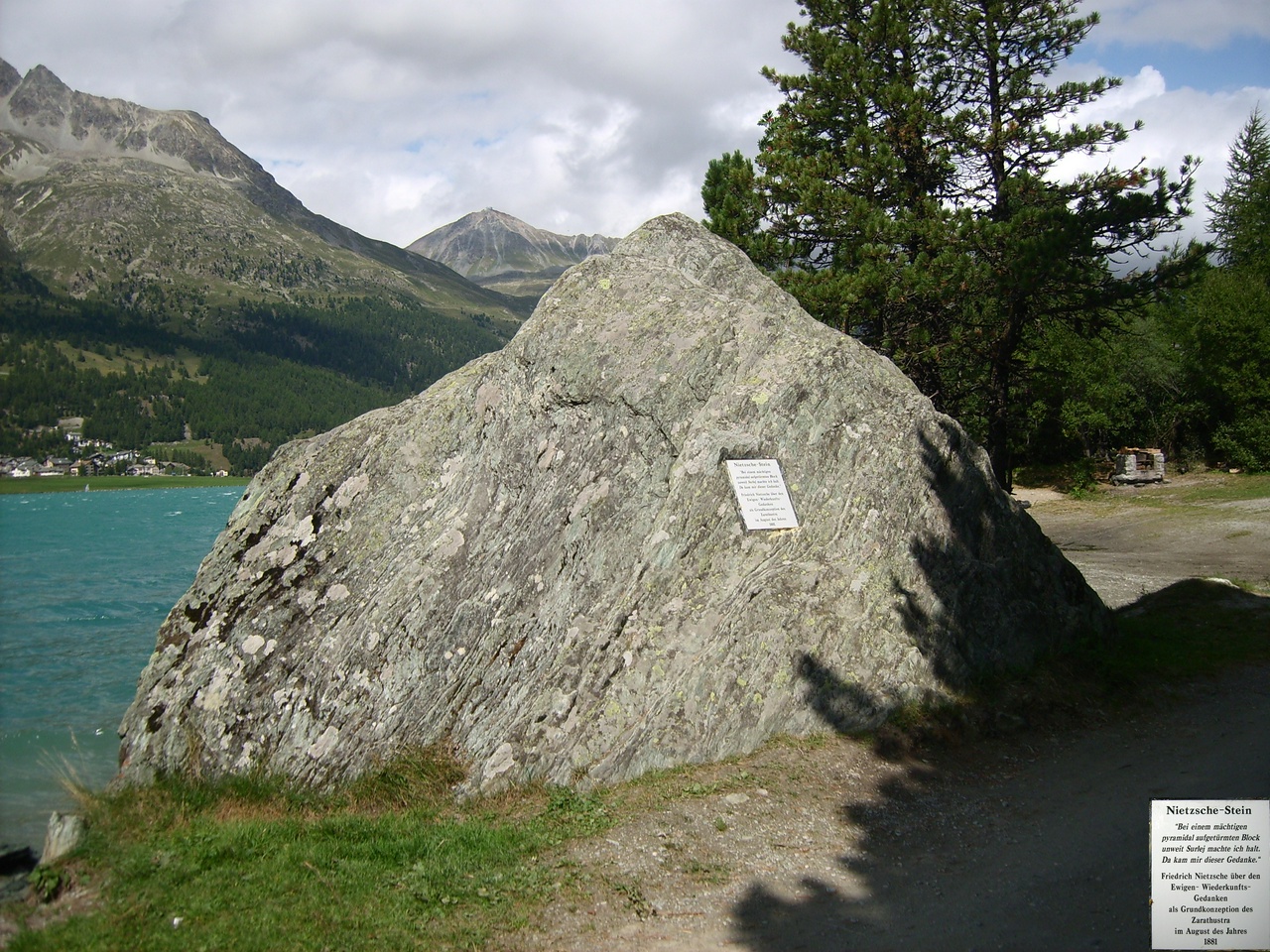
The Nietzsche Stone on the shore of Lake Silvaplana. Photo by Armin Kübelbeck, Wikimedia Commons (license).
